As part of our Lunch & Learn series we were joined by Vickie Williams, Independent Panel member of Menstruation Friendly
We all may have heard the word “endometriosis”. But what does it feel like to live with it? What advice might help? How can people be best supported?
Henpicked: First, can you explain what endometriosis is?
Vickie Williams: Endometriosis – or endo for short – affects one in 10 women worldwide and 1.5m women in the UK. The medical definition is ’tissue resembling the lining of the uterus that’s found outside the uterus’. The lining of the uterus, the endometrium, is thick and dense. It’s built for growth, essentially. The lining of the uterus, the endometrium, is thick and dense. It’s built for growth, essentially.This similar tissue can grow onto the ovaries or invade other organs such as the bladder or bowel. It also behaves in a similar way to the endometrium, building and then breaking down and shedding with every menstrual cycle except there’s nowhere for it to escape to so it becomes trapped within the body.
This causes inflammation, scar tissue, adhesions and a whole host of other unpleasant symptoms. People can experience heavy and painful periods, back and leg pain, bloating and constipation, diarrhoea, pain when going to the toilet or having sex, infertility, depression. The list goes on and on. Symptoms are highly individual, and everyone experiences endo differently.
Henpicked: Will you tell us a little of your own story?
Vickie Williams: My own journey started when I was 11 with a series of fainting episodes just before I started my period. It took 10 years for me to be diagnosed. That’s 10 years of going back and forth to the doctors, being told it’s all in my head, it’s just a bad period.
When I was eventually diagnosed it coincided with me starting my first job, and I had to figure out how to manage my symptoms, which was often in silence. My endo disrupted everything, I was having to cancel plans with friends and family and it interfered with relationships. And it had a huge effect on my work. One day I was sitting at my desk and it was as if a bomb had gone off in my pelvis. I asked if I could leave work and went to A&E, the doctor there put me into an induced menopause to manage my pain.
At the same time, I got an email from my boss, warning me I’d left without giving a handover. As you can imagine, being in that level of pain this is the last thing I’d had on my mind. Similar experiences cropped up throughout my career: a real lack of understanding.
I started teaching yoga, which I was drawn to both for the relief of symptoms and the perspective it gave me of living with a long-term condition. Along with a friend, I set up endo sharing circles. These were a mixture of movement, meditation, self-coaching and advice on nutrition. During these circles, I realised how much of an impact working with endometriosis could have on people, which sparked my own studies. Many told me about having to have repeated time off, losing out financially or on promotions, and how discriminatory their experiences were.
I really started to question how endometriosis is understood, treated and managed in society.
Henpicked: What kind of things did you discover during the course of your research?
Vickie Williams: The biggest challenge with endo can be the diagnostic delays of 8-12 years. It’s often called the missed disease as there are such a wide spectrum of symptoms and it’s repeatedly misdiagnosed. I was also horrified at the normalisation of menstrual pain, the only type we seem to think as a society is okay. It takes on average seven appointments before you get referred to a specialist. And you’re often left without evidence to prove you’re suffering, which makes it hard to explain absences or you need extra accommodations at work.
There’s no real structure in place to support people with endo in the workplace, we see time and time again that people are being penalised instead of supported. In a study across 52 countries, over 40% of women with endo had become unemployed.
Henpicked: Is there anything people can do to help themselves?
Vickie Williams: You can create your own evidence and diaries are very useful here. On a medical basis, you’re capturing your pain and symptoms over a few months, so you can go to your GP and tell them how it’s impacting on your everyday activities. You can ask to be referred to a specialist at a BSGE accredited endometriosis centre, where they have specialist consultants and surgeons etc. They also have endo nurses who are incredible, they bridge the gap between the social and medical worlds. To be honest, it can just be a relief to talk and be heard.
Diaries are also useful in the workplace, so you can start to identify patterns. For example, if your symptoms tend to flare in the morning you could discuss with your manager things like a later start time. You don’t have to show them your diary, but you can explain that you’ve been tracking symptoms and this is what you need – it’s a great way to open up dialogue.
They can also be self validating, after years of possibly being told your symptoms are all in your head you can now the impact of endo in black and white.
Gentle movement can help, but tailor it to how you’re feeling each day. And look at your nutrition to see if there are any triggers. I find meditation helps. There’s no cure, but I find this helps me be more accepting and find breathing techniques to help during the pain. Above all, don’t be too hard on yourself.
Henpicked: Are there any myths you can bust?
Vickie Williams: Yes, pregnancy or hysterectomy won’t cure endometriosis. Endo responds to oestrogen, and there’s so much in our environment which mimics this, it isn’t just about the oestrogen our body produces.
Henpicked: Apart from the diaries, is there anything you could recommend for the very short GP appointment?
Vickie Williams: Yes, look at the NICE guidelines beforehand. These will show you the diagnosis pathway and treatments you should be offered. You can also show these to your GP, it puts the power back into your hands a bit.
Henpicked: Are there any apps for tracking symptoms?
Vickie Williams: I use the Flo app but there’s also Clue, amongst others. There’s also a great app called Frendo, which is a community for endo sufferers. It can be a very isolating condition, and it’s often a relief to share symptoms and talk about the common difficulties with others.
Henpicked: And what about in the workplace, what can managers do?
Vickie Williams: It’s all about education and awareness, not dismissing people or their experience. Managers don’t need to be clinical experts but showing a level of empathy by listening and attempting to understand, whilst also creating a safe environment to discuss supportive adjustments can be extremely helpful.
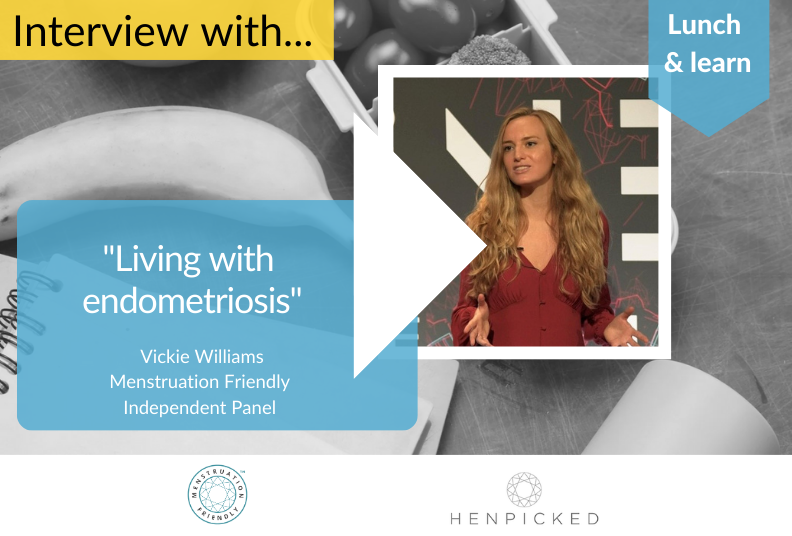
Vickie, driven by her own experience with endometriosis, pursued a PhD in People and Organisations at The Open University UK, focusing on endometriosis in the workplace and the impact of menstrual policy.
She holds a first-class honours degree in Business Management from King’s College London, where her interest in gender and organisational studies began, particularly regarding women’s workplace experiences. Before her PhD, Vickie spent seven years as a Digital Account Director in film and creative agencies across London.
Concurrently, she trained in women’s health and established her own business to support individuals with endometriosis and other gynaecological conditions. Vickie has shared her expertise on endometriosis at prominent venues, including Guy’s and St Thomas’ Hospital, London, and the International Critical Management Studies conference.
Her personal and professional experiences provide her with unique insights into the challenges faced by women with invisible and often debilitating gynaecological conditions.
She is particularly interested in how workplace structures and practices can better accommodate these conditions, aiming to improve the work environment for affected individuals.