As part of our Lunch & Learn series of webinars, we were joined by Dr Rebecca Williams of Williams Stress Management.
 Fluctuating hormones during menopause affect the way we respond to stress both physically and emotionally. But why and how? And what can you do about it?
Henpicked: Menopause and stress, what does one have to do with the other?
Dr Rebecca Williams: They are inextricably linked. Menopause doesn’t fall into a neat little box that is separate from everything else going on in our lives. It can come at a time of significant challenge, when we might have young children or teenagers, caring responsibilities for older parents, relationship challenges, maybe going through divorce, separation, or be widowed. Add to that financial and work pressures and potential health conditions and it’s easy to see how it can be a time of anxiety and pressure.
For many women going through menopause, vasomotor symptoms (flushes and sweats) are a major challenge. They can cause repeated wakening through the night, leading to sleep disruption which in turn impacts our ability to function day to day, and our health in general. Many women also experience physical changes, such as hair thinning or loss, body changes, muscle aches and joint pains, brain fog, low mood and anxiety. These symptoms of the menopause can exacerbate symptoms of stress: which can exacerbate symptoms of menopause. So it’s a real cauldron of challenge for women.
For some there’s very little that changes, for others it can be quite dramatic. It’s really important for women to understand that managing stress and menopause can be done in similar ways – excluding medical treatments.
Henpicked: What do people tend to do when they’re stressed?
Dr Rebecca Williams: It’s really common to engage in unhealthy coping behaviours. We tend to reach for quick fixes to help us feel better quickly, which can actually worsen symptoms of menopause. People often use alcohol as a stress reliever, to feel less anxious, to help them relax or to sleep (but although it’s sedating it doesn’t give good quality sleep). Alcohol is highly calorific and contributes to weight gain, can cause spikes in blood sugar, worsen sweats and depress mood. It really does have a very negative impact on some aspects of menopause.
Comfort eating is another common behaviour that creates blood sugar spikes and affects mood and weight. Food and alcohol can also become addictive, taking over our lives.
For those who don’t sleep well, caffeine can often be their go-to, keeping them going through the day. But it’s a stimulant and can increase their heart rate and risk of flushes, sweats and palpitations.
All three of these coping behaviours can worsen symptoms of menopause.
Henpicked: What is the stress reaction? How does it manifest?
Dr Rebecca Williams: We use the word stress a lot but often don’t think about what it really means. In order to understand the complex physiology of stress we need to look at our acute stress response, or the fright/fight/flight response. This is an evolutionary adaptation to life-threatening situations and enables us to respond with increased strength, speed, energy and alertness. Essentially, it is designed to keep us alive.
When we’re faced with a dangerous situation our primitive brain, the oldest part of our brains in evolutionary terms, recognises the danger and responds. And it generates a response aimed at keeping us alive, activating systems designed to make us stronger and faster. So, our heart and breathing rates go up, muscle tone increases, cortisol levels go up, and we become more alert and sensitive to what is going on around us.
In turn, it suppresses systems that are a drain on our resources, like our gut and sexual reproductive system. Also, and very significantly, the primitive brain suppresses the front part of our brain, the pre-frontal cortex, where we do our rational thinking, objective decision making, memory processing and where we control our emotions. We don’t need these things in an acute situation. Once the danger passes all our systems go back to their resting state. It’s a really important response, even today, because it saves lives.
However, for most people experiencing stress in the 21st century, it’s not a life-or-death situation and it’s not short lived. However, it still generates a response from the primitive brain. It could be a threat to our self esteem, our values, our cultures, leading to a lack of confidence and leading to us feeling uptight and anxious.
So when someone is dealing with stress, their higher-functioning brain won’t be working as well. They’ll struggle to think clearly, to make good decisions, to remember things and to control their emotions. The complex physiology of stress means that people may develop health problems and these can further impact their ability to function.
When people are stressed they’re more likely to engage in unhealthy coping behaviours which can further exacerbate things. So we can see how stress is potentially harmful and how the menopause combined with stress adds further spice to our bubbling cauldron. It can be a relentless spiral. We struggle to think clearly and start perceiving more and more things as threats.
Different people handle pressure differently. Some don’t function well under pressure, others are highly motivated and energised by it. Whichever you are there may come a point when that pressure becomes too much and tips you into stress.
Henpicked: The big question is: what can we do?
Dr Rebecca Williams: One tool I like to use is the serenity prayer. Grant me the serenity to accept the things I cannot change, the courage to change the things I can, and the wisdom to know the difference. Or the CIA acronym: control, influence, accept. We need to conserve our energy for the things we have control or influence over and not ruminate over things we can’t change. Make a list of your own stressors, look at each in turn and decide if there’s any way to make them less stressful.
In terms of unhealthy coping behaviours, my message is to let things be a treat, not a treatment. When you’re reaching for a glass of wine or a packet of biscuits, ask yourself ‘why?’ Maybe it’s because you’re anxious. But is there anything else you can do? Are you drinking caffeine because you’re not sleeping well? If so, what can you do to improve your sleep?
Address the ‘why?’ and employ ‘simple joys’ which are more healthy. What are the little things in life that make you happy? Maybe drinking your morning tea in your favourite mug, looking at the garden. ‘Simple joys’ are the little things you can do quickly. When you feel stressed, reach for one of your simple joys and let them uplift you.
Mindful living is also extremely good for our mental health. A lot of our stress is when we’re analysing things we’ve said or done or worrying about things that might or might not happen in the future. Mindful living is about focusing on what you’re doing right now. It means feasting your senses. If you’re eating a meal, look at it, look at the colours, feel the texture, smell it, taste it. Look at the garden, embrace your senses in each moment of your life.
An attitude of gratitude can help you focus on the positives. It’s very easy to get caught up in the negatives, but when something goes wrong it affects how we perceive other things and before we know it we’re having a ‘bad day’. Try to make a conscious effort to notice the little positives in the day to bring some balance.
For your physical health, try some breathing exercises. When we’re feeling anxious and stressed our breathing becomes shallower and faster, which then enhances the feeling of stress. Focus on breathing exercises that help you breathe longer and deeper. Six-eight is a good one to remember: breathe in for six and out for eight.
Or try diaphragmatic breathing into bottom of your lungs, which makes your belly stick out. The movement of the diaphragm triggers a nerve impulse to your heart, slowing it down and reducing your blood pressure. You can find lots of demos of this on You Tube, showing you how to put your hand between your belly button and rib cage, and you should see your hand going up and down.
Movement is also key. Of course, exercise is important if you can, but it’s important to move as much as possible. Especially if you’re at a screen a lot. Get up regularly and move your shoulders, arms, hips and legs, don’t just stay in one position all day.
For your spiritual and emotional health, try to incorporate nature into your day. This could be watering plants in the house, going for a walk, watching the birds, anything you enjoy. Noticing the natural world is incredibly therapeutic.
Doing things you enjoy makes a huge difference. I’ve touched on simple joys but think about the bigger ones, too. Spending quality time with people you love and doing things you love will help to recharge you.
If you do find you’re in overwhelm and panicking there are two things that will help. The breathing which I’ve mentioned. Also, a grounding technique called 54321. Say out loud five things you can see, four you can touch, three you can hear, two you can smell and one you can taste. This will help to switch off your primitive brain and get your rational brain back into gear.
Finally, there is the STAN tool, which is particularly important if you are really struggling:
Spending time with people who make you feel good about yourself.
Talk to someone about how you’re feeling
Ask for help – this is a sign of strength, not weakness.
No. Put in boundaries and recognise your limitations.
Henpicked: These are fantastic tips. Is there anything else we could try?
Dr Rebecca Williams: I really recommend a stress self-check-in around once a month. See how you’re feeling, what your current stressors are and how you’re coping. Are things getting out of control? Then you can look to some of these tools and methods to reset yourself and get your rational brain back in charge.
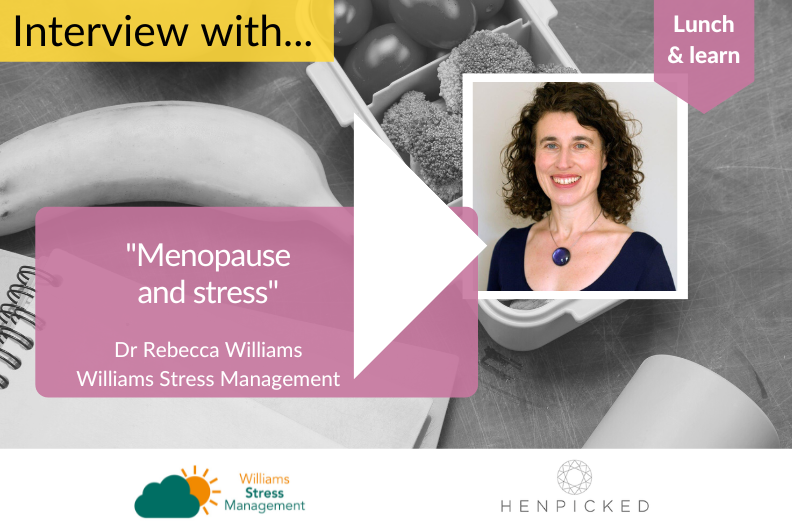 Dr Rebecca Williams works with businesses and organisations to reduce presenteeism, absenteeism and high staff turnover and with individuals struggling with stress.
Having worked as a GP for over 20 years, she has witnessed, first-hand, the impact of stress on mental, physical and emotional health and has signed many fit notes for stress. Through this work, she has gained valuable insights into how to help people in a practical way and utilises her skills in her role as a Stress Management Consultant.
Following her medical training in Cambridge and Oxford, she moved to Scotland for her GP training and has worked as a GP in the Scottish Borders ever since. Inspired by her clinical work and driven by her desire to educate, equip and empower people in looking after themselves, her stress management work offers a proactive approach to stress. Her services include online webinars, on-site workshops and individual one-to-one online support sessions.
And here’s a link to Dr Rebecca Williams’ book: Dealing with Stress: The ‘Mind, Body, Spirit Way‘ and to her article Stress and menopause.