As part of our Lunch & Learn series we were joined by Dr Clare Spencer of My Menopause Centre rated ‘outstanding’ by the Care Quality Commission. She gave her advice and tips on how to get a good night’s sleep during menopause.

Henpicked: First of all, can menopause cause issues with sleep?
Dr Clare Spencer: Absolutely. The figures vary according to surveys but we know over 60% of women do struggle with sleep as they transition through menopause. So it’s a very common issue.
Henpicked: Why is this?
Dr Clare Spencer: There are many factors and it’s usually a combination of these rather than just one. The effect of low hormones on the brain can impact on sleep. And we know that 8 in 10 women will experience vasomotor symptoms, hot flushes and night sweats, which impact on sleep by themselves. Psychological symptoms such as anxiety and low mood can wake us up with our brain whirring in the middle of the night.
Then there are other physical symptoms, for example if your bladder is irritable and you have to get up in the night, while some conditions like restless legs and sleep apnea can worsen during menopause. We also need to factor in what’s going on in our lives, which can often be a lot.
In short, symptoms affect sleep and sleep affects symptoms. It can become a vicious cycle.
Henpicked: Is this what we’d call insomnia?
Dr Clare Spencer: Insomnia is a common sleep disorder. With insomnia, you may have trouble falling asleep, staying asleep or getting good-quality sleep.
Henpicked: Is there an end to it?
Dr Clare Spencer: Most menopause symptoms do get better with time and as this happens sleep can improve by itself. However, increasing age can sometimes impact sleep.
Henpicked: What can we do?
Dr Clare Spencer: There are many strategies and options. Non-medical solutions include practising good sleep hygiene. This is all about setting up a routine that gears you up for sleep. Avoid looking at a screen for around an hour before bed. And do whatever helps you relax – take a bath or read a book, for example. Make sure you associate your bedroom with sleep (so try to avoid working in there) and keep it cool, dark and comfortable.
If you wake in the night don’t lie there for more than about 20 minutes. Get up and make a non-caffeinated drink and then go back to bed. Don’t do something over stimulating or switch all the lights on, for example.
While it’s tempting to have a glass of wine to help you sleep, this won’t keep you asleep and can make anxiety worse. Also try to avoid caffeine after lunchtime as this can linger for a long time, and fast-release carbs before bed can also cause sleep issues.
On a medical level, there is evidence that HRT can be helpful, particularly if you have micronised progesterone (utrogestan) as we know this can get you into a deep state of sleep. Remember, it can take around three months for HRT to take effect, so you might need to stick with it for a while. If you’ve had a hysterectomy, you won’t have been offered progesterone, but you can have a discussion with your practitioner about this. And for those on a two-week-on, two-week-off progesterone, you might need to focus on your sleep hygiene on the two weeks off.
If you are really desperate then you could speak to your GP for a short course of sleeping tablets, just to break the cycle. But we don’t advise you take these for any length of time as it’s easy to become addicted.
Henpicked: Can Cognitive Behavioural Therapy (CBT) help?
Dr Clare Spencer: Absolutely. In fact, the intervention with the best evidence is probably Cognitive Behavioural Therapy for Insomnia. This is about rethinking how you think about sleep, and it teaches you techniques to get out of that cycle of lying in bed worrying about getting to sleep. There are some good apps out there, things like Sleepstation and Sleepio, some of which are available through the NHS. There are also some good resources on Women’s Health Concern.
Henpicked: What about melatonin?
Dr Clare Spencer: Melatonin is only officially indicated for short-term treatment of jet-lag in adults but can help you to get to sleep and lengthen total sleep time. There are usually restrictions to GP prescribing melatonin. Please do be careful about buying these products online though as doses and quality can vary. Melatonin may have a place in the menopause for women who are really struggling but where HRT is thought to be risky
Watch the video here:
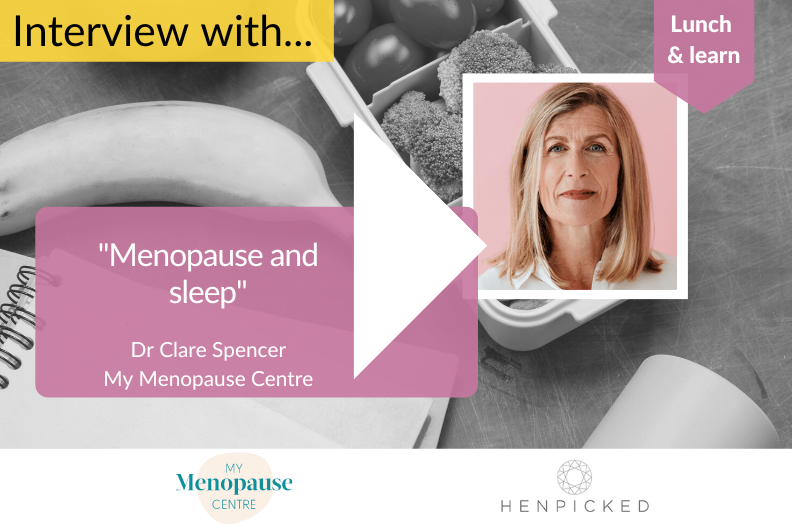
Henpicked Menopause in the Workplace’s Deborah Garlick was joined by Dr Clare Spencer of My Menopause Centre.
Dr Clare Spencer is a registered menopause specialist and an NHS GP. She qualified from Cambridge University and holds membership of the Royal College of Obstetricians and Gynaecologists and the Royal College of General Practitioners. She initially trained in obstetrics and gynaecology where she gained a Doctor of Medicine for research in fetomaternal medicine.
As well as her role of Clinical Director at My Menopause Centre, she currently runs an NHS menopause service and is a GP partner in a practice in Leeds. She is also a British Menopause Society menopause trainer and is involved in educating GPs about the menopause transition through talks, lectures and seminars. She wrote the menopause training module for doctors.net and has written for the Primary Care Women’s Health forum publication, Her Life Her Health, on a variety of menopause-related topics.
Check out the rest of Henpicked’s Lunch & Learn video series!

Available from Bloomsbury, Waterstones, Amazon and good bookshops.