As part of our Lunch & Learn series we were joined by Dr Clare Spencer of My Menopause Centre to talk about menopause and our pelvic floor.
Henpicked: First and foremost, what is our pelvic floor?
Dr Clare Spencer: In the base of our pelvis we have a big sheet of muscle and connective tissue that keeps our pelvic organs in place. By pelvic organs I mean the bladder, uterus, cervix, vagina, rectum and anus. The pelvic floor is a band of muscle which keeps all of that up and in place.
Henpicked: What are the changes that could happen as we age and go through menopause?
Dr Clare Spencer: There are oestrogen receptors in the pelvic floor muscle. When we lose oestrogen during menopause, these receptors don’t get plugged so the pelvic floor becomes weaker. The collagen in our connective tissues also loses its integrity so it becomes thinner. Things can just start to sag. Ageing results in muscle weakness, and tissue thinning, and the nerves don’t work as well as they used to.
Henpicked: When could this start to happen?
Dr Clare Spencer: Some people do have a naturally weaker pelvic floor. Other risk factors include anything that increases pressure on that muscle, in your abdomen, so pregnancy, childbirth, chronic constipation, coughing, smoking, carrying extra weight.
Henpicked: Our pelvic floor affects a lot of areas of life doesn’t it? Sex life, poo, wee…
Dr Clare Spencer: Yes, hence the taboo and the massive embarrassment, which is why it’s so good we’re talking about it here. A weak pelvic floor can affect your bladder and bowels, and impact on the intensity of orgasms.
Henpicked: What are the symptoms of a weak pelvic floor?
Dr Clare Spencer: A lot of people don’t have any symptoms. Some women will be walking around with a degree of prolapse which isn’t affecting them in the slightest. If the prolapse is affecting your bladder you might notice leaking when you cough, sneeze or run,. Some people feel they need to empty their bowels or leak when exercising. There might also be a loss of sensation during sex.
Prolapse by definition is all of our pelvic organs heading south. So people might feel they have a bulge in their vagina, a dragging feeling, others can almost feel something coming out of the vagina. And sometimes there’s lower back ache and pelvic discomfort.
Henpicked: What can we do to get the right help and support?
Dr Clare Spencer: It depends what your symptoms are. Prevention is the first option. This means doing pelvic floor exercises like you’re training for a marathon. It’s almost like a lifelong commitment, strengthening and maintaining your muscles. Essentially, these exercises are where you squeeze your muscles, as if you’re trying to stop a flow of urine or stop poo from coming out. The Squeezy app is an excellent resource to help you with these exercises.
You can also look at things like losing weight, if you need to, as this will reduce some pressure on your pelvic floor. If you suffer from constipation, speak to your doctor, as getting that sorted could also help.
If it’s a physical issue with a prolapse then as well as pelvic floor exercises you can try pessaries, a rubber ring that sits inside the vagina and basically hold everything up. Surgery can also help, but pessaries are a good temporary fix while you’re waiting.
Henpicked: Can HRT help?
Dr Clare Spencer: There isn’t a lot of evidence around this but it makes sense that HRT would help. The vagina can become thin, dry and delicate after menopause and lose elasticity. Systemic HRT – tablets, patches or gels that go into your system – could be effective. But if people don’t want to take this or their main symptom is vaginal then a local vaginal oestrogen can be really effective. In fact, probably about a third of women who take a systemic HRT also need a vaginal oestrogen as well, and it’s fine to take both. And the majority of women can take vaginal oestrogen on its own.
You need a prescription so speak to your GP. There are very few contra indications for vaginal oestrogen, and the NICE guidelines say you can take it for as long as you need. It carries no risk of breast cancer or blood clots.
Henpicked: Can a weak pelvic floor get better, or are we just avoiding it getting worse?
Dr Clare Spencer: It depends on how bad it is. Absolutely there is good evidence that pelvic floor exercises will prevent it getting worse. If you’ve got mild prolapse they can help reverse it. If it’s severe it can help to a degree but it may be a longer slog. You can ask for a referral to a gynae physiotherapist in most areas on the NHS and they can advise you on your best course of action and make sure you’re doing the correct exercises.
Henpicked: How often should we do these exercises?
Dr Clare Spencer: The general guidance is two or three times a day, start with 10-15 reps and work up. Pilates is also a really good way of strengthening the pelvic floor. It is possible to over exercise the pelvic floor – though this is not common. If you are worried about muscle tension (which can sometimes cause pelvic pain) please speak to your doctor or physio.
Henpicked: What about urge incontinence?
Dr Clare Spencer: This can be another consequence of the menopause. When you lose oestrogen your bladder is more prone to squeeze before it needs to. Using a vaginal oestrogen or HRT can help and there is other medication that your GP can prescribe. Caffeine and alcohol can make your bladder contract more so try to avoid or limit these.
Some people do find exercise can make them feel they need the loo or leak a little, but please don’t let this stop you doing the exercise you enjoy. Make sure you’re doing your pelvic floor exercises, get some good trainers to reduce impact and minimise your risk factors as much as possible. If you can, speak to a physiotherapist who specialises in the pelvic floor as they will be able to guide and advise you on what exercise is suitable for you. This is particularly important if you feel your pelvic floor muscles are becoming weaker through exercise.
Watch the video here:
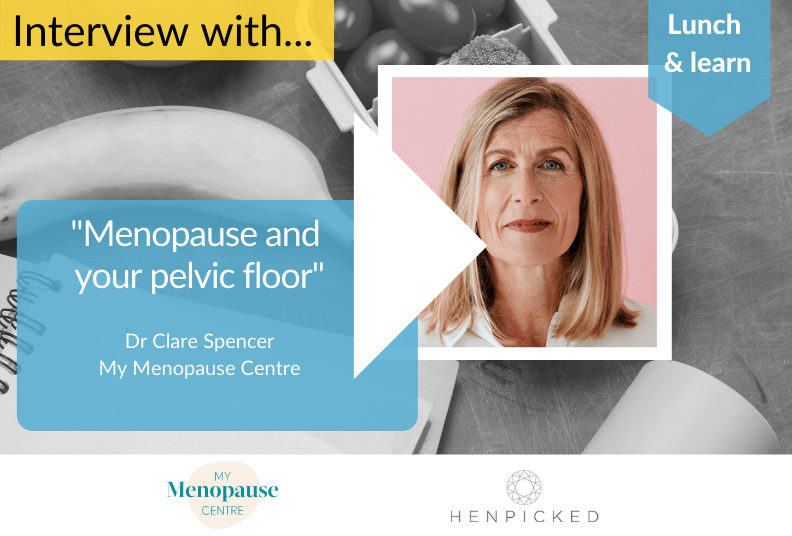
Henpicked’s Deborah Garlick was joined by Dr Clare Spencer of My Menopause Centre.
Dr Clare is a registered menopause specialist and an NHS GP. She qualified from Cambridge University and holds membership of the Royal College of Obstetricians and Gynaecologists and the Royal College of General Practitioners. She initially trained in obstetrics and gynaecology where she gained a Doctor of Medicine for research in fetomaternal medicine.
As well as her role of Clinical Director at My Menopause Centre, she currently runs an NHS menopause service and is a GP partner in a practice in Leeds. She is also a British Menopause Society menopause trainer and is involved in educating GPs about the menopause transition through talks, lectures and seminars. She wrote the menopause training module for doctors.net and has written for the Primary Care Women’s Health forum publication, Her Life Her Health, on a variety of menopause-related topics.