As part of our Lunch & Learn series of webinars, we were joined by Antonia de Gier of Hormone Health.
In this session we discussed what everyone needs to know about menopause and nutrition.
Henpicked: How does what we eat make a difference to us during menopause?
Antonia de Gier: Many of us worry about our weight but it’s not just about what we look like. Extra weight is not good for our heart health, and it can put a strain on our joints and bones.
Over the years we might have tried different diets generally cutting out food groups, like the Keto diet or the Atkins diet. A lot of us have also probably avoided fat. But during menopause, there are three main food groups called macronutrients we need to focus on, along with the smaller food groups, the micronutrients, in particular during menopause.
Henpicked: So now isn’t time for a restrictive diet?
Antonia de Gier: No, it’s not the right time for a quick fix or new fad. We’re in a new phase of life but this can be a positive time, a time to look at how we nourish our bodies. Portion control is still important. But it’s about getting the right food into our body to support every system.
The key thing to hold onto is that, for the majority of us, if we can get our food right then generally cravings reduce, the blood sugar spikes and dips can become more level, our energy and mood can improve, we can sleep better. It can all have a knock-on effect on how we’re feeling.
There are three main food groups: let’s start by looking at protein.
We know our muscle mass starts to decline from about age 35. If we don’t have muscle then in general we’ll have more fat. We need protein to support muscle. We also need protein to maintain our bones and help with skin and hair health. Proteins are the building blocks for our neuro transmitters, sending them signals for how we want our hormones and other mechanisms to work. So very important for memory and mood.
Protein also helps to balance our blood sugar. Many of us find we have lows where we crave a sugary snack, which sends our blood sugar straight up, then we’re back to square one when it comes back down again. That can affect our mood swings and lead to weight gain. What protein does is help to slow down our digestion of all foods and gives us a much more sustained level of energy.
Henpicked: Should we have protein at every meal then?
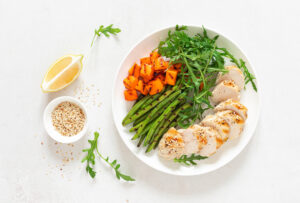
Antonia de Gier: If there’s one golden rule of nutritional advice it’s to have protein with every meal and snack. Lots of people skip breakfast as they’re trying time-restricted eating or to restrict their calories. Or they just don’t give it much focus, just having a quick coffee and a piece of toast. But protein is really important in the morning. Think eggs, salmon, nuts, seeds, with full-fat yogurt, unsweetened nut butter with oatcakes. These will all help get you going in the morning and get blood sugar started on an even keel, leading to a more balanced energy level.
It’s important to ask: ‘is this food giving my body the right nutrients?’ not ‘is it low calorie or low fat?’
Henpicked: Are all proteins the same?
Antonia de Gier: Proteins include foods like fish, lean chicken and grass-fed meat. If you’re avoiding meat or eggs, you could try tofu, which is very good for gut health, nuts and seeds, or there are a lot of vegan alternatives now. Variety is the key. Pulses are very good too, things like lentils, chickpeas, kidney beans – these are important for vegetarians, vegans and meat eaters alike.
Henpicked: Tell us about the second food group.
Antonia de Gier: The next thing to consider is good fats. There are certain fats that we need which we can’t make in the body. Cholesterol is the precursor for our sex hormones, oestrogen and progesterone. These are the hormones which decline and fluctuate when we come into perimenopause. And we need fats to metabolise and balance these hormones. This is why eating the good fats is so important. They can also help with our satiety response, knowing when we’re full, so are helpful in appetite control.
Good fats can have an anti-inflammatory effect on the body. So if you’re getting a lot of joint pain or aches and pains, these good fats can really help.
Henpicked: What are some examples of good fat?
Antonia de Gier: We’re talking about things like avocado, oily fish (salmon, mackerel, sardines), nuts, seeds and their oils (sesame seeds and oil, rapeseed and oil). In an ideal world nuts and seeds would be raw and unsalted, such as Brazils, almonds and cashews. But if you’re craving a snack then salted cashews, for example, will be more beneficial than crisps.
Henpicked: And what is the third food group?
Antonia de Gier: Carbohydrates, which have had a raw deal over the years! There have been so many low-carb diets and they do work as a quick fix. But our metabolisms change as we age. The big thing to remember is that carbohydrates are our main energy source. We all feel tired at the best of times and have busy lives so we do need these food groups to help us sustain our energy levels. I’m talking about complex carbs, which are slow releasing. Wholewheat bread, pasta, rye bread, oatcakes, fruits and veg. Some people have become scared to eat fruit thinking it’s high sugar, but fruits are full of vitamins and minerals that we need at this stage of our lives. Within this food group I’d include fibre, which again is so important to help us eliminate old circulating hormones and with our digestion in general.
Henpicked: What would be my portion size of the three groups?
Antonia de Gier: Breakfast could be an egg with avocado and yogurt with nuts and seeds and fruit. Then you’re covering all groups. I can’t stress enough that if you attempt to eat the right foods, after a couple of weeks your body will really notice the difference and you are unlikely to be craving snacks. But if you are, then try 6-10 almonds or a teaspoon of unsalted nut butter with an apple. In an ideal world we’d have three balanced meals a day and not need to snack. But of course there will be times we do want or need to snack. It’s just important to remember to have protein with every meal and snack.
Henpicked: You also mentioned vitamins and nutrients?
Antonia de Gier: Yes, B vitamins and vitamin C and D. Minerals like magnesium and selenium help to support our energy, metabolism, mood, and the synthesis of our neuro transmitters. Take, for example, one transmitter, acetylcholine. This is important for our memory. It’s made from a substance called choline, which we get from fish, organ meats and eggs.
B vitamins are a very good source of mood-enhancing substances, found in green leafy veg like spinach and kale, turkey and cottage cheese. Magnesium is very important as a muscle relaxant and can aid our sleep. Sources are cashews, almonds, green leafy veg. For blood sugar balance chromium and selenium are very important. You’ll find chromium in parsnips, wholegrains, and variety of nuts, selenium is found in Brazil nuts. Just two a day can give you the amount of selenium you need.
Henpicked: Should we take multivitamins?
Antonia de Gier: I’d say always start with the diet, but I am an advocate for supplements. Vitamin D is important to supplement, as it supports our bone health because we simply don’t obtain enough from sunlight in the UK.
Probiotics are an excellent idea, either in supplements or in our food. They’re important if you’ve been ill and your immunity has taken a hit. If you’ve taken antibiotics it can kill good as well as bad bacteria. You’ll find them in things like live yoghurt and some cheese such as Gouda and mozarella and onion, garlic, and fermented foods like sauerkraut, kimchi and kefir.