As part of our Lunch & Learn series here’s award-winning Jackie Lynch, founder of the WellWellWell Nutrition Clinic and author of The Happy Menopause who specialises in women’s health and the menopause. She joined us to discuss how to improve your sleep naturally during the menopause transition.

Henpicked: This has been such a popular webinar, it makes me wonder: is anybody getting a good night’s sleep? What’s going on?
Jackie Lynch: There’s a lot going on! We all know we’re better for a good night’s sleep. If we don’t get enough sleep we can be irritable, less productive and just generally not feeling top of our game. It does mess with our physical and mental health and wellbeing. The problem with midlife is there’s always such a lot going on. Of course if you’re struggling with hot flushes and night sweats that’s going to disrupt your sleep. But even if you’re not prone to those particular menopause symptoms there are still hormonal surges occurring and these can cause you to suddenly wake up. They can cause disruption so even if you stay asleep it’s a restless sleep and you don’t wake up feeling refreshed.
And we can’t ignore the impact of stress. Midlife really is the most stressful time of a woman’s life, we’re juggling so many things. If you have children you might have the clash of hormones where menopause meets puberty, you might be struggling to care for elderly relatives, professional women usually have more responsibility at work. Money worries, health worries, relationships. And when you put a cocktail of hormones together and you mix them up with your stress hormones it’s a perfect storm. At the very moment you want to lie down and relax the opposite happens.
Henpicked: From a natural point of view, what can we do to help ourselves?
Jackie Lynch: There are lots of things and I think it’s important to be proactive and not put up and shut up. You can make your bedroom a more sleep-friendly space, particularly if you struggle with hot flushes and sweats. There’s some great clothing out there now specially designed for menopausal women which can be better than cotton, it’s absorbent so you don’t get all clammy. Having the windows open, a lighter duvet, practical things like that.
From a food perspective the first thing to do is sort your blood sugar out. If you can fall asleep quickly but wake up for no apparent reason in the middle of the night and it’s not a hot flush, the chances are it’s your blood sugar. As it crashes, it releases stress hormones and their job is to create a fight-or-flight response. So you get a big surge of adrenaline and cortisol. If you’re fast asleep, cortisol is saying ‘wake up wake up there’s a danger on the way’. You wake up and can’t get back to sleep. So you need to be thinking carefully about what you’re eating in the day but especially in the evening. Because with blood sugar, what goes up must come down.
Henpicked: Is our blood sugar directly related to how much sugar we eat?
Jackie Lynch: Unsurprisingly, things that make the blood sugar go up can be sugary foods like cakes, biscuits and chocolate. But refined carbohydrates are also a factor. The body breaks down things like white bread, rice and pasta much more quickly than the wholemeal versions. If you have a big bowl of white pasta in the evening with tomato sauce your body’s going to burn through that really quickly and you’ll have a blood sugar crash.
When it comes to foods one of the nutrients that supports our sleep is a compound called tryptophan, an amino acid which is used by the body to produce serotonin, which in turn produces melatonin. This is the hormone which governs our sleep and wake cycles. It’s designed to rise in the evenings and get us ready to sleep and fall in the morning so we spring out of bed. It works in direct opposition to cortisol which is supposed to rise in the morning and fall in the evening. When we’re too stressed those two can swap over and you can subvert that process.
Foods that are rich in tryptophan can help with that calming element. Milk is a good source of tryptophan, as are oats. So sometimes oat drinks or warm milk with oat biscuits or oat cakes can help to balance blood sugar before bed, particularly if you eat your dinner early. A snack before bed isn’t always a bad shout.
Amino acids are found in protein-rich foods, so protein is a really good idea, because it supports tryptophan levels and helps to balance our blood sugar. The combination for blood sugar balance is protein and complex carbohydrates. Protein is hard to digest so it slows down the release of the carbohydrate and keeps you going longer. Add some tuna or prawns to your wholemeal pasta dish, or try nuts, seeds and chickpeas. This will help to balance your blood sugar and stop you crashing.
Henpicked: A lot of people like having drinking chocolate before bed. Is this a good idea?
Jackie Lynch: Depending on the powder you use there can be quite a lot of sugar in these drinks so you could be starting a spike. But also, chocolate contains caffeine. We often forget this and think of tea, coffee and diet drinks, but dark chocolate is a big source. So you need to be careful having this in the evening as it can keep you awake. Not everyone is sensitive, but if you’re having a dark drinking chocolate that could be enough to tip the balance. It’s really the warm milk, not the chocolate, that can help you sleep. Other options, such as malted drinks, can be more effective than chocolate.
We have to recognise we all have a different capacity to process caffeine in the liver, as it’s down to a particular enzyme. Some people can drink coffee all evening and sleep like a log and others have a cut-off point when they can’t have tea or coffee after that and still get to sleep. It’s worth noting that levels of this enzyme can change, especially around menopause. So don’t assume because you could always do something that you still can. You could do a little audit of what you’re having and see what you might need to change, if anything.
Henpicked: What about a glass of wine?
Jackie Lynch: The two great enemies of sleep are caffeine and alcohol, as they are both powerful stimulants. Alcohol is a double-edged sword. You might think a little nightcap will help you get off to sleep, and it can. But it’s worth remembering that alcohol is a sedative, so it won’t be a natural sleep. The more alcohol you have the more you’ll be prolonging the REM phase of sleep which is when we dream.
Our sleep cycles run for 90 minutes and they comprise different types of sleep. REM lasts about 20 minutes of that 90-minute cycle. If that’s prolonged you’re likely to have a poor sleep and waking feeling unrefreshed. It takes an hour for our body to process a unit of alcohol, so a single gin or vodka using a proper measure is easier to keep track of. But wine is tricky because it depends on the strength, so you could be having more units than you think.
I often recommend people take three consecutive alcohol-free days each week as a minimum. The consecutive bit is important as it gives your liver time to do other jobs like processing hormones, metabolising fat and producing energy. And you’ll find that you sleep much better those nights. It’s not about never having a glass of wine, but if you struggle with sleep it’s very much going to be part of the picture.
Henpicked: Can being too full prevent us from sleeping?
Jackie Lynch: Yes, too full a stomach can also wake you up especially if you have IBS or you’re prone to bloating. Think about having a peppermint tea to ease digestion after dinner. Valerian, camomile or lemon balm tea can all help to calm you down and get you ready for sleep.
Henpicked: Anything else we should perhaps avoid?
Jackie Lynch: There’s another amino acid called tyramine, which converts to noradrenaline. This is our arousal neurotransmitter, which gets us up and going. Not what you want when you’re trying to get to sleep! You’ll find this in things like bacon, salami, and aged cheeses. So if you’re struggling, try to stay away from the cheese and cured meat platters with a glass of wine.
Henpicked: And what else should we be aiming for in our diets?
Jackie Lynch: Magnesium is a game changer when it comes to sleep, particularly if you struggle to switch off. It’s nature’s calmer, it helps to regulate the nervous system and calm your stress response, helping you feel much more relaxed. Leafy green veg are the best natural source of magnesium, things like rocket, cabbage, kale, watercress and broccoli. Or you could have an Epsom salts bath, which is magnesium sulphate. Add two or three handfuls to your bath and soak for about 20 minutes, or use it in a foot bath. Magnesium regulates muscle function, so can help if you have restless legs.
Also worth giving a shout out to calcium, which you’ll also find in leafy green veg. It’s great for bone strength, but it helps to regulate our sleep cycles. Think of those 90-minute cycles I mentioned earlier. You need to complete them. If you wake during a cycle, when you go back to sleep you won’t go back to where you were. You start a new cycle. If you don’t complete a number of cycles you’ll feel rough in the morning. You might think you’ve slept for eight hours but you have broken a lot of cycles so it’s not very relaxing for you. Whereas you might only have five hours but you’ve completed every cycle so you feel more refreshed.
Henpicked: What about supplements?
Jackie Lynch: You can get magnesium in multiple forms. Look for something absorbable, so citrates, glycinates and picolinates. Sulphates, carbonates and oxides are less easy to absorb, but do tend to be cheaper.
I’d look for a magnesium citrate or glycinate. Citrate is good if you have a sluggish bowel as it can galvanise what’s going on with your stools. If you’re prone to loose stools you’d be better off with a glycinate as it doesn’t aggravate the gut.
B vitamins are also a good idea. These are a family and work together in synergy. A deficiency in one usually means a deficiency in another. Most good quality multivitamins and minerals have a good range of the B vitamins in, or you can buy a vitamin B complex.
If you’re looking to supplement with calcium it’s really important to make sure your vitamin D isn’t low. Most products now have a combination of calcium and vitamin D, as you can’t absorb calcium without vitamin D. Increasing research shows if you’re low in vitamin D that could also be a cause of insomnia.
If you have a medical condition or are taking medication, check first with your doctor before taking supplements. Magnesium, for example, can bring your blood pressure down so could be an issue if you’re taking blood pressure tablets.
Henpicked: What should we do if we’re just feeling tired all the time?
Jackie Lynch: If you’re exhausted all the time you need to see your doctor and they can run some tests. If you’re low in B12 you’ll feel exhausted, and this can be a factor with plant-based or vegan diets. The body can store B12 for a year or two but it can run out. Or if you can’t absorb it well you might need injections. You might be low in vitamin D, or need iron, if you’re perimenopausal and flooding and losing a lot of blood.
Assuming everything’s been ruled out and it’s not your thyroid that’s making you feel tired all the time, I’d look at magnesium. This is the ignition key, it really kickstarts your energy production process. If you’re tired all the time and operating on willpower, chances are you’re low on magnesium.
Always go back to your blood sugar. What are you eating and drinking, and how much of it? Aim to make a quarter of your meal protein, a quarter complex carbs, and the rest of it vegetables, preferably some leafy green veg.
Watch the video here:
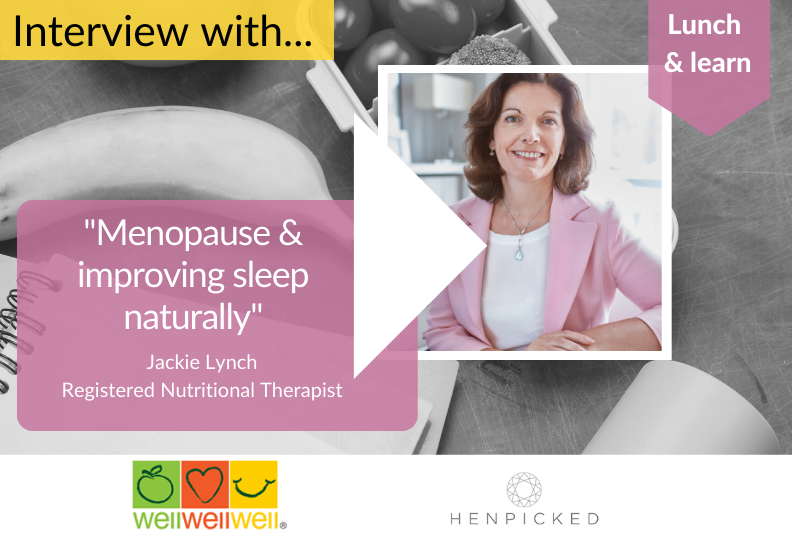
Jackie Lynch is the founder of the WellWellWell Nutrition Clinic where she specialises in women’s health and the menopause.
She’s a regular contributor of nutrition features in the media and her clinical work has inspired her to publish the following books:
- Va Va Voom: The 10-Day Energy Diet (Headline, 2017)
- The Right Bite: Smart Food Choices for Eating on the Go (Nourish 2016)
- And her amazing latest book, The Happy Menopause – smart nutrition to help you flourish (2020).
She’s also the host of the popular diet & lifestyle podcast, The Happy Menopause – you can find out more here:
Check out the rest of Henpicked’s Lunch & Learn video series!

Available from Bloomsbury, Waterstones, Amazon and good bookshops.