As part of our Lunch & Learn series we were joined by Dr Marilyn Glenville PhD of Glenville Nutrition, who specialises in women’s health.
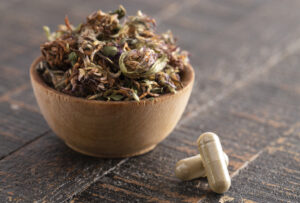
Maybe you have been told you can’t take HRT because of a personal history or family history of breast cancer. Or maybe you have decided HRT is not for you but still want help with symptoms such as hot flushes and night sweats.
Nature provides us with herbs which can be very powerful tools when you are going through the menopause.
In this session we covered the different herbs that are useful around this stage in your life and highlight those that are particularly beneficial during the perimenopause.
Henpicked: What herbs are helpful for us during menopause?
Dr Marilyn Glenville: Certain herbs are more beneficial depending on if you’re in perimenopause or menopause. If we think about perimenopause, the lead up to menopause, hormones could be fluctuating quite wildly. For some women the symptoms at this point are mood swings, irritability and anxiety, rather than hot flushes and night sweats. Agnus Castus is a good herb here, as it has a balancing effect on hormones.
It’s helpful for those who have symptoms which feel like magnified premenstrual symptoms. It’s classed as an adaptogenic herb, which means it’s got a balancing effect. In fact, it’s helpful at any stage in a woman’s life when hormones may be out of balance, but is particularly good in perimenopause before periods stop completely.
Henpicked: Sounds great. Are there any others?
Dr Marilyn Glenville: Another herb of choice would be Black Cohosh. This has a lot of evidence in the medical literature for what are known as the vasomotor symptoms – hot flushes and night sweats. But I’ve found it’s better to use a combination of herbs rather than single ones. We’re all sensitive to different things, and identical symptoms don’t always respond to the same herbs in different women. A combination can sometimes be more effective and faster.
Other good herbs to try are Hops, Wild Yam and Red Clover. A herb which doesn’t directly work on menopause symptoms but is nonetheless good is Milk Thistle. This is the herb of choice for our liver. And in any hormone transition or imbalance, it’s our liver that has to metabolise the hormones into a harmless form before they’re excreted out of the body.
Henpicked: We hear about sage a lot?
Dr Marilyn Glenville: Yes and there’s been some really good research on that. In one study it decreased hot flushes by 50% after four weeks and 64% after eight weeks. It showed a nearly 50% reduction in perimenopause symptoms, including anxiety, tension, insomnia. You can use it as a tea, but if symptoms are strong I’d suggest a powdered capsule form.
Henpicked: How often would you take herbs and how long for?
Dr Marilyn Glenville: Take them until the symptoms go. Food, vitamins and minerals are very different. They work on our general health to keep us well and keep our energy up. Herbs are used to address specific problems, and once they’ve gone you can stop taking them. So this doesn’t have to be a long-term thing, unlike taking a multivitamin and mineral.
Henpicked: Is there much research surrounding herbs?
Dr Marilyn Glenville: Yes, there are some good studies and more came out in 2002. This was after the Women’s Health Initiative study which raised issues concerning HRT and breast cancer. Scientists thought if women weren’t going down the HRT route as much they needed to look at the herbs and make sure they’re safe and effective. I would say they’re not as effective as HRT. Herbs aren’t a medication. But we know from the medical literature that the herbs we’re recommending are safe and beneficial.
Henpicked: Can there be any side effects from herbs?
Dr Marilyn Glenville: In a few cases. But if people use products and brands with integrity there isn’t usually an issue. We know there will be some herbs which have contraindications, like St John’s Wort and certain medications.
Henpicked: What’s the best way to take herbs?
Dr Marilyn Glenville: I always suggest going for capsules if possible. Tablets can contain binders to hold the tablet together. And tablets can also contain non-active ingredients like lubricants and anti-caking agents, which have no nutritional benefits.
You probably look at labels on food and avoid certain artificial sweeteners and colours etc. I’d say do the same with anything else you buy. You don’t want things that aren’t needed, so avoid the same things you would in food. Make sure it’s a really clean product and you’ve just got what you need in that capsule and nothing else. If something needs to be chewed or is in liquid form it often has sugar or sweetener in it.
Henpicked: What would we look for in an expert to advise us?
Dr Marilyn Glenville: Often nutritionists work with herbs, but there are also herbalists who work solely with herbs. My Glenville Nutritional Clinics in the UK and Ireland have been working remotely since the first lockdown so we are happy to provide help no matter where people live and can organise nutritional testing at a distance too. It’s about getting the right advice and it’s not always easy to find the right combination on your own. Trial and error can feel quite disheartening and can be costly and time consuming.
Henpicked: Can you mix herbs and HRT?
Dr Marilyn Glenville: No, it’s one or the other. If a woman is on HRT she doesn’t need herbs because HRT should be doing its job. If your HRT isn’t effective, speak to your GP to try a different brand or different method of taking it. We occasionally do use herbs if someone is weaning themselves off HRT, as there can sometimes be withdrawal effects.
Henpicked: What about supplements and vitamins if you’re taking HRT?
Dr Marilyn Glenville: Supplements and vitamins and minerals are very different to herbs. I would suggest a multivitamin and mineral designed specially for menopause, so will contain things like antioxidants, calcium, D3 and digestive enzymes. I’d also think about Omega 3 fatty acids, which we get from fish oil. Oestrogen has anti-inflammatory effects and as it reduces it can lead to joint pains. Omega 3 is good for our joints, skin, hair and brain cells. They’re classed as essential fatty acids because we can’t make them in the body. Vitamin C is important for our immune function and also acts as an antioxidant and helps the body manufacture collagen which is important for our skin and bone health.
Henpicked: Finally, are there any other herbs we could consider for menopause symptoms?
Dr Marilyn Glenville: Olive Leaf and Turmeric can be good for joint pain. Valerian, Camomile, Tart Cherries and Lemon Balm can help with sleep. Again, combinations can be better than taking them on their own. I’d always advise you to see your doctor if you’re suffering from something like extreme fatigue, to rule out anaemia, an underactive thyroid or vitamin deficiency.
Watch the video here:
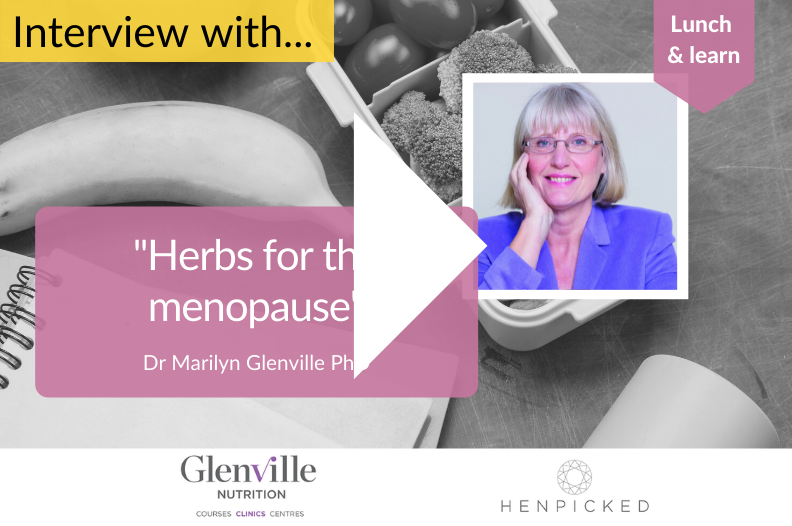
Dr Marilyn Glenville PhD is the UK’s leading nutritionist specialising in women’s health. She is the Former President of the Food and Health Forum at the Royal Society of Medicine and the author of a number of internationally bestselling books including ‘Natural Solutions to the Menopause’.
*She also made this special offer to all our readers:
There’s more information here:

*This is not a sponsored or paid for post and we have received no money for advertisement.
Check out the rest of Henpicked’s Lunch & Learn video series!